
INTERNATIONAL STUDENTS | BACHELOR’S DEGREE IN ECONOMICS
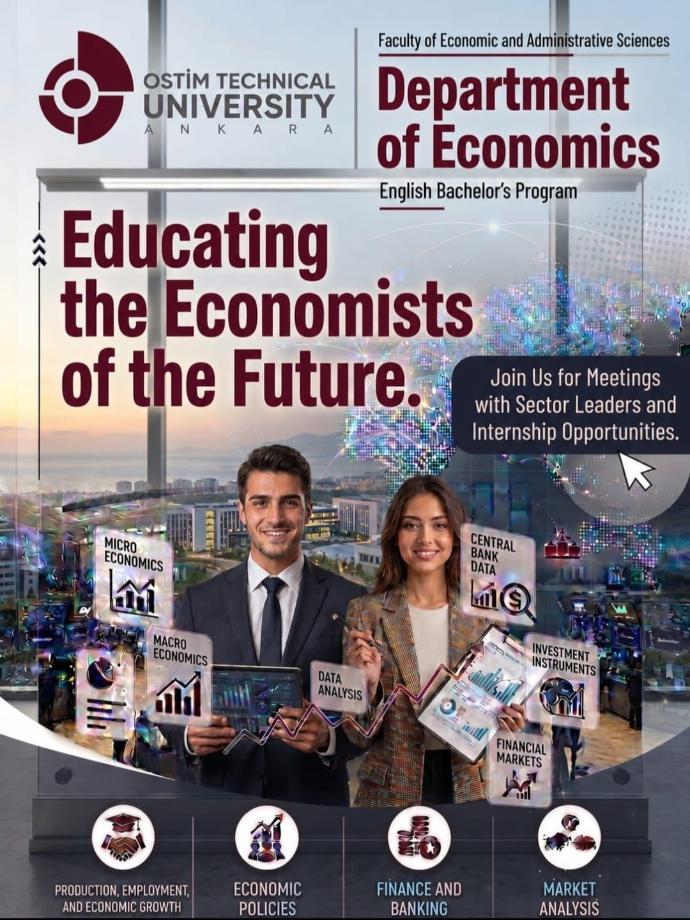
Analyze the Economy. Shape the Future.
Study Economics in English in Ankara and connect economic thinking with data, industry and technology.
Economics helps us understand the choices behind everyday life and global change. Why do prices rise? How do firms grow? How does technology transform production and employment? Why do countries follow different development paths? At OSTİM Technical University, you will learn to examine these questions through economic theory, analytical methods and real-world evidence.
Why study Economics at OSTİM Technical University?
- You will enter professional life as a “Work-Experienced Graduate.”
- You will receive your education in English.
- You will have the opportunity to learn a second or third foreign language.
- Thanks to the Department of Economics’ dynamic curriculum, which is updated annually, you will graduate equipped with up-to-date knowledge and skills.
- By participating in national and international conferences organized by our Department of Economics, you can expand your academic, professional, and social networks.
- Our Rector, Prof. Dr. Murat Yülek, a globally recognized economist, is also a faculty member of the Department of Economics.
- You will have internship and employment opportunities at companies operating within the OSTİM ecosystem.
- Through Erasmus+ and partnerships with international universities, you will have the opportunity to study abroad and gain international experience.
- By completing a double major, you can earn a second degree; through a minor programme, you can gain additional expertise and receive a certificate in another field.
- In addition to gaining a solid foundation in economic theory, you will develop competencies in econometrics, data analysis, artificial intelligence, finance, sustainability, and the digital economy.
- Through the university’s entrepreneurship ecosystem, incubation centres, and strong industry connections, you will have the opportunity to develop your own business ideas and gain entrepreneurial experience.
- In a university environment closely integrated with industry and the business world, you will be able to observe and explore the practical effects of economic policies on production, technology, entrepreneurship, and international trade.
Where can an Economics degree take you?
Graduates of the Department of Economics can pursue careers across a wide range of fields, from banking and financial institutions to public-sector organizations, and from national and international companies to research centres. Our graduates can work in departments specialising in economics, finance, budgeting, analysis, planning, strategy, foreign trade, and risk management.
Graduates who develop strong skills in econometrics, statistics, and data analysis can build careers as economists, data analysts, business analysts, financial analysts, risk analysts, market analysts, and policy analysts across various sectors. The analytical thinking, problem-solving, forecasting, and decision-making skills gained through an economics education enable graduates to adapt effectively to the changing demands of the business world.
Career fields include:
- Public institutions: Central banks, ministries of finance, economy and trade, statistical offices, stock exchanges, regulatory and supervisory authorities, development agencies and other public-sector organizations.
- Banking and finance: Commercial and participation banks, investment funds, insurance companies, portfolio management firms, financial technology companies and other financial institutions.
- International organizations: Multilateral development banks, international financial institutions, regional development organizations and United Nations agencies.
- National and international companies: Positions in economic analysis, finance, budgeting and reporting, strategic planning, pricing, market research, business analysis and risk management.
- Consultancy and auditing: Economic and management consultancy, independent auditing, tax advisory, financial consultancy, investment advisory and corporate strategy.
- Foreign trade and international business: Export and import operations, international marketing, logistics, supply-chain management and global market analysis.
- Digital economy and technology: E-commerce, financial technologies, digital platforms, economic forecasting and data-driven decision-making.
- Sustainability and the green economy: Green finance, energy economics, sustainability management, carbon markets and environmental, social and governance analysis.
- Academic and research careers: Postgraduate study and careers at universities, research centres, policy institutes and think tanks.
- Entrepreneurship: Establishing a business, developing a start-up or working as an independent researcher or consultant.
|
Study Economics in English in Ankara. Understand markets, work with data and prepare for a career that can cross sectors and borders. |